Best Time to visit Nepal
Discover the best time to visit Nepal based on weather, trekking seasons, festivals, and sightseeing opportunities. Plan your perfect Nepal trip with our seasonal travel guide.
January in Nepal
• Tiger safaris start
• Coldest month
• Low season for trekking
In Nepal, January is a very cold month. Even in this coldest month, when average minimum temperatures are around 1°C, snowfall is rare in Kathmandu. The middle of January marks the start of the tiger observation season. The tall grass at Bandipur National Park is trimmed by the people for roofing material, which makes it easier to spot wildlife. This time, there are not many hikers. Snow may block high mountain passes, thus it is advisable to check conditions before leaving, use lower routes, or be prepared for other routes.
February in Nepal
• Warming up at the end of the month
• Still cold at night
• Few crowds
February in Nepal is cold at first, but as the month goes on, it begins to feel more like spring. Trekking season begins in late February. There are not many people, but cloud cover may make it difficult to see the high peaks; trekking at lower elevations may be more comfortable. The Holi celebration may take place near the end of February, bringing a pop of color ahead of the next month's spring blooms.
April in Nepal
• High-altitude trekking
• Rhododendrons
• Hot at low altitude – for tiger watching
In April, hikers are welcomed into Nepal by rhododendrons. It is sunny in Kathmandu, and it is getting hot in the lowlands. You may be fortunate enough to witness tigers visiting water holes in Chitwan National Park if you do not mind temperatures between 30 and 40 degrees Celsius. Trekking in colder climates is recommended since the snow has melted from the passes, allowing you to ascend above any low clouds.
May in Nepal
• Warm to very hot
• Last good month for hiking and wildlife
• Monsoon approaching
May is one of the warmest months in Nepal. It is also the quiet before the storm: when the monsoon season approaches, clouds start to form and showers start to pour. In Pokhara and Kathmandu, it can be hot and muggy with afternoon showers; in Chitwan National Park, it can reach 35°C. Before the rain arrives, sneak to Everest Base Camp for the opportunity to meet several fascinating trekking groups on their way to the summit.
Nepal Travel Guide
Historical Monuments - Kathmandu, Patan, and Bhaktapur Durbar Squares, Narayanhiti Palace Museum,
Natural Wonders - Annapurna Region & Pokhara (Phewa Lake), Chitwan National Park, Sagarmatha National Park
Hidden Gems - Bandipur, Panauti,Tansen (Palpa)
Religious Sites - Pashupatinath Temple, Boudhanath & Swayambhunath Stupas, Lumbini (Maya Devi Temple), Janaki Mandir (Janakpur)
June in Nepal
• Start of monsoon
• Upper Mustang remains dry
• Some trekking trails and roads closed
With the exception of the far north, where the Mustang and Dolpo regions are under a rain shadow, June is monsoon season in most of Nepal. This is an excellent time to travel to places that are extremely cold outside of summer. In June, there would be no hiking in other parts of Nepal. Landslides and floods block roads and trails, and leeches proliferate. Due to impassable roads, national parks are closed for animal viewing.
July in Nepal
• Peak monsoon
• Farmers hard at work in rice paddies
• Trekking trails and tea houses closed
It’s the wettest month of the monsoon crosswise Nepal in July. In Pokhara, one of the rainiest spots in the nation, almost 80cm of rain falls in the month. Among June and July, you must be encounter the Ropain Festival, which marks the start of rice paddy planting season – the monsoons un for farmers. If you want to trek, go to the dry and distant Upper Dolpo or Upper Mustang, or hop
August in Nepal
* still hot and wet
* Last monsoon month
* Trekking trails and tea houses closed
As with all monsoon months at this point, it doesn’t essentially rain every day, but it does rain every day; the monsoon rains tend to fall in the late daylight or at night, and mornings can be dazzling and apparent. Rice paddies are verdant with green shoots and water rushes throughout the valleys. It’s still a good time to go to the Dolpo and Mustang region.
September in Nepal
• Start of autumn trekking season
• Some rain might stick around
• Better at end of the month
The teahouses on the trekking trails are open once more to guests. Nepal in September sees the monsoon dying, and by the end of the month, rain has totally cleared and the country is fresh: insects, dust and cloud washed away. Months of stable weather and clear skies are to follow. As September progress, the climate just gets improved and enhanced.
October in Nepal
• Most popular trekking month
• Stable weather
• Loads of walking options
The way the replenish landscapes spring to life in autumn is stunning. Don’t forget your camera. This is the perfect and the majority well-liked month for trekking, but for amazing diverse, Nepal in October is also a nice time for rafting. As weather change extends the monsoon, October remnants the most dependable dry, cloud-free trekking month.
November in Nepal
• Clear skies
• Stable weather
• Great for trekking
Nepal in November must be experience its clearest skies of the year, which means nice vision of mountain peaks. There are simple trekking situation all the way from side to side this month previous to the quieter season start in colder December. Tihar, the Diwali-like fair of lights, lasts for five days approximately this time of year. In Nepal, it mainly celebrates animals, and it’s a lovely time to be in the country.
December in Nepal
* Snow leopard spotting
* trekking in popular areas still possible
* Colder and quieter
In Nepal in December, it’s getting cold and it’s the end of the busy trekking season. However, it’s not insufferably cold, and it’s still possible to trek if you’re ready to be supple just about the colder climate at altitude, and the possibility of detouring due to snow. You can do the Annapurna Circuit or walk in the Everest region. It’s also a nice time to seem for snowstorm leopards.
Best Local Dining Names in Nepal
-
Kathmandu: Thamel House Restaurant, OR2K, Bhojan Griha, Newa Lahana
-
Pokhara: Moondance Restaurant, Fresh Elements, The Old Lan Hua Chinese Restaurant
- Chitwan: KC's Restaurant, Friends Café
- Lalitpur (Patan): Café Swotha, Honacha
- Nagarkot: Café du Mont
Nearby Places to Visit in Nepal
-
Kathmandu: Pashupatinath Temple, Boudhanath Stupa, Swayambhunath, Kathmandu Durbar Square
-
Pokhara: Phewa Lake, Davis Falls, Sarangkot, Gupteshwor Mahadev Cave
-
Chitwan: Chitwan National Park, Sauraha, Tharu Cultural Village
-
Lumbini: Maya Devi Temple, Lumbini Monastic Zone
-
Bhaktapur: Bhaktapur Durbar Square, Nyatapola Temple
-
Nagarkot: Himalayan viewpoints and sunrise points
-
Bandipur: Traditional Newari town and mountain viewpoints
-
Janakpur: Janaki Temple
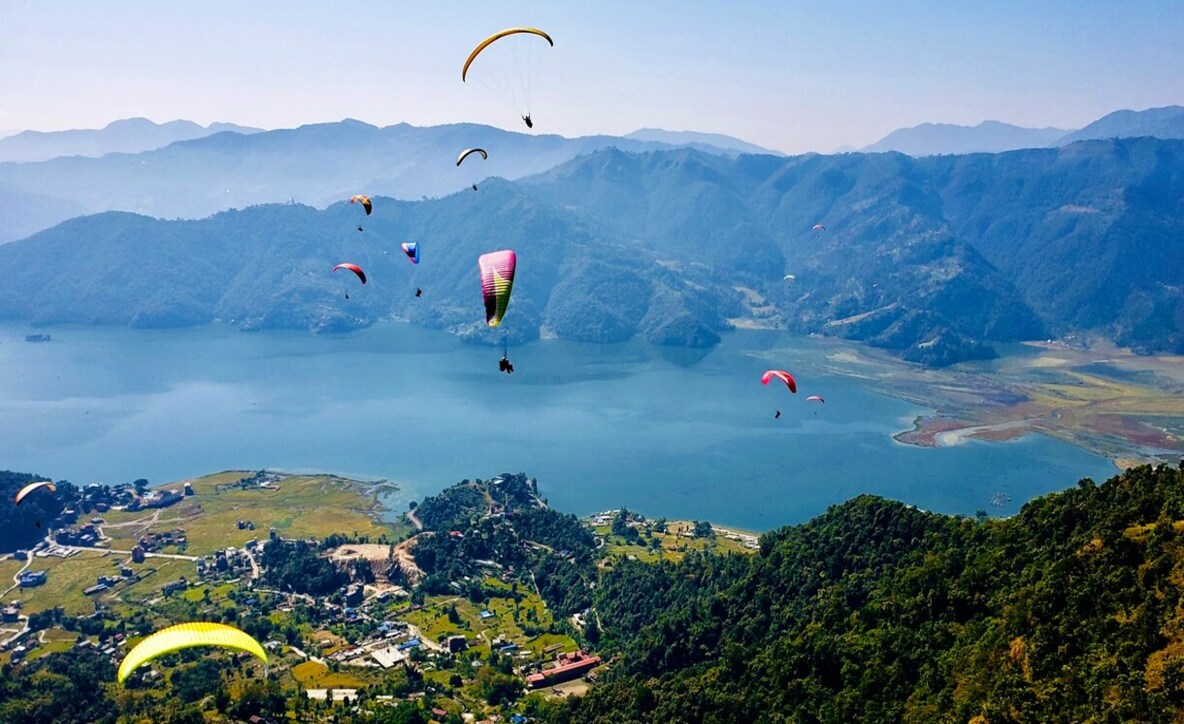
Activities to Do in Nepal - Trekking in the Annapurna and Everest regions, Paragliding in Pokhara, Boating on Phewa Lake, Jungle safari in Chitwan National Park, White-water rafting, Mountain photography, Sunrise viewing in Nagarkot and Sarangkot, Exploring Buddhist monasteries, Visiting Hindu temples, Mountain biking, Exploring local markets and traditional villages, Cultural experiences and Nepali food tours
Reach Nepal by Train & Flight
By Train: Nepal does not have a direct international railway connection with most major Indian cities. Travellers from India can take a train to a railway station near the India–Nepal border and continue by road. Raxaul Railway Station is convenient for reaching Birgunj, while Gorakhpur Railway Station is useful for reaching the Sunauli border near Bhairahawa. Jogbani Railway Station is another option for travellers entering through the Biratnagar border area. From these border points, buses, taxis and other road transport services are available to reach destinations such as Kathmandu, Pokhara and Lumbini. Road travel time depends on the border crossing and destination.
By Flight: The main international air gateway is Tribhuvan International Airport (KTM) in Kathmandu, which connects Nepal with several international destinations, including Indian cities. Travellers from India can find direct flights to Kathmandu from cities such as Delhi, depending on airline schedules. For domestic travel within Nepal, flights connect Kathmandu with destinations such as Pokhara and other regional airports. Pokhara International Airport and Gautam Buddha International Airport in Bhairahawa are additional airports useful for domestic and selected international services. Flying to Kathmandu is generally a convenient option for travellers planning a tour covering Kathmandu, Pokhara, Chitwan and nearby destinations.
Best times to visit Nepal for festivals & events
Holi (February or March)
Holi is a celebration that takes place over three days in either February or March and is referred to as the festival of hues or the festival of affection. It is customary to toss vibrant powders at one another; despite its strong religious significance, it evokes a playful spirit in all, leading to grown-ups pursuing one another in joyous fits of laughter.
Tiji (mid-May)
A request for global harmony this is the essence of Tempa Chirim, often known as Tiji or Tenchi. This Buddhist celebration lasts three days and features monks driving away malevolent forces through rituals and dancing in Lo Manthang, the capital city of Upper Mustang, a remote and less frequented area in the northwestern part of Nepal. Local residents may also discharge firearms to confirm that the spirits have genuinely departed.
Ropain (June)
Few tourists travel to Nepal in the rainy season, yet this is when the rice fields are seeded, accompanied by a festival to honor the emergence of new green plants and rising waters. During Ropain, individuals head to the rice fields to get them ready for sowing. Melodies are expressed, and maybe a little mud is tossed as folks enjoy themselves in the damp fields. The customary meal enjoyed is beaten rice with yoghurt.
Teej (August or September)
Dressed in red sarees and sporting red tikas, women of the Hindu faith in Nepal commemorate Teej through joyous feasting and dancing. During this occasion, they pray for the well-being and long life of their husbands; however, it's primarily a celebration for women. They enjoy a day off from work and many married women visit their families from childhood. This festival also fosters a sense of sisterhood and provides an opportunity for women to express themselves in a culture that frequently silences their voices.
Dashain (September or October)
Dashain, one of the largest festivals in the nation, is a Hindu observance that honors the harvest and symbolizes the triumph of good against evil, especially the conquest of the goddess Durga over the demon Mahishasura. The festivities can extend over a period of 15 days, with each day holding its own unique meaning and activities. A key aspect of the celebrations includes the sacrifice of animals, which takes place on the eighth day.
Tihar (October or November)
Anticipate a five-day celebration in Nepal for the festival dedicated to light. In Nepal, the Hindu population particularly honors various animals. Different days are set aside for venerating crows, dogs, cows, and oxen, with dogs, oxen, and cows decorated with floral garlands. On the fifth day, the focus shifts to those without fur. This day is primarily for siblings to acknowledge one another, followed by a communal feast for all. It is a wonderful period to be in the nation.
Quick Info:-
What is the best month to go to Nepal?
The best months to visit Nepal are Autumn (September to November) for apparent skies and trekking, and Spring (March to May) for heater climate and blossoming rhododendrons, offering hit the highest point trekking and traditional experiences with vivacious festival like Dashain and Tihar. Winter (Dec-Feb) is vast for town and low-elevation trips, as summer (June-Aug) suits natural world screening and rain-shadow treks.
Is Nepal visa free for Indians?
Yes, Indian people do not require for a visa to go in Nepal for sightseeing, thanks to the Indo-Nepal agreement of calm and Friendship; they just require suitable identification like a passport or Voter ID card for entrance by air or land. As visa-free, proper documentation is necessary, and working in Nepal still requires work permission.
Which month is best in Nepal?
The best time to visit Nepal is pre- and post-monsoon (March to April and September to November), mainly if you want to go trekking. Spring (March to May) is a mainly stunning season as the rhododendrons are in blossom.
When not to visit Kathmandu?
Monsoon season in Nepal runs from June through to August and is certainly not a time to visit. Heavy rain and wide spread landslides make tour around the state hard and so many traveler amenities will close up downhill for the time.
Can I go to Nepal with an Aadhaar card?
No, an Aadhaar card is not a applicable tour text for toward the inside Nepal; you require a suitable Indian passport or an Election ID card (Voter ID) for air travel, as Aadhaar cards are particularly excluded for border crossings to Nepal and Bhutan, despite being necessary for home use in India
What are the rules for Nepal?
Don't disrespect the Nepali flag, national anthem, or royal family. Don't take photos without permission, particularly of populace or sacred sites. Don't litter or pollute the environment. Don't trek alone or without a licensed direct, particularly in remote areas.
Which part of Nepal is most beautiful?
The "most beautiful" location in Nepal is subjective, but Pokhara (for lakeside serenity and Annapurna views), the Everest Region/Sagarmatha National Park (for dramatic Himalayan grandeur like Mt. Everest), and Upper Mustang (for unique arid landscapes and Tibetan culture) are always ranked as pinnacle contender, along with religious places like Lumbini and wildlife havens like Chitwan National Park.
When to avoid Nepal?
You must be stay away from visiting Nepal in the peak monsoon season (June to September) due to serious rains, landslide, muddy trails, and probable flight disruption, make trekking hard and dangerous, although few town seeing the sight remnants probable. Another time to reconsider is in periods of political unrest, which can involve protests and violence, and potentially the powerful heat of pre-monsoon summer (May) or the excessive cold of peak winter (December-February) in elevated altitude if looking for warm climate trekking.
What is the food like in Nepal?
The Nepali staples consist mainly of rice, wheat, corn and lentils, in adding up to bright vegetables and meats. A typical Nepali each day meal can be characterize by Dal (lentil soups), Bhat (steamed rice), and Tarkari (vegetable preparations), also known as “The Trinity,” supplemented by few meat preparation.
Related Packages